

- 5 min read
A Complete Guide to Medicare Enrollment: Everything You Need to Know
Medicare enrollment sounds simple: turn 65, sign up, get coverage. The reality is more tangled, with separate enrollment periods, rules tied to whether you still work, and lifelong penalties for signing up wrong.
This guide covers it plainly: who needs to enroll, when each window opens, how to apply, and how to avoid the mistakes that cost people money. By the end, you will know which enrollment period fits you and what your next step is.

What Is Medicare Enrollment?
Medicare enrollment is the process of signing up for coverage, whether that happens automatically or through an application you submit yourself. Signing up during the right window keeps your coverage on time and your premiums penalty-free.
Medicare is the federal health insurance program for people 65 and older, plus some younger people with qualifying disabilities.
Timing is what people underestimate. Some coverage starts automatically, and a lot does not. Assume the government handles everything when you need to apply, and you can face a coverage gap or a lifelong surcharge.
The parts of Medicare work differently at enrollment.
- Part A (hospital insurance) is premium-free for most people; many enrolled automatically.
- Part B (medical insurance) usually requires action and costs $202.90 a month in 2026.
- Part D (prescription drug coverage) is optional but carries a late penalty if you skip it without other creditable coverage.
- Part C (Medicare Advantage) and Medigap are private plans you choose after Original Medicare is in place.
Our overview of what is Medicare breaks down each part and how they fit.
Social Security Medicare enrollment is automatically triggered for some individuals, particularly those already receiving Social Security benefits before age 65. However, if you’re not receiving Social Security benefits, you’ll need to take active steps to register for Medicare.
Who Needs to Enroll in Medicare?
Medicare eligibility falls into a few clear groups. You generally need to enroll if you fit one:
- People turning 65 – this is the most common path.
- People who have received Social Security Disability Insurance (SSDI) for 24 months.
- People with end-stage renal disease (ESRD) who need dialysis or a kidney transplant.
- People diagnosed with amyotrophic lateral sclerosis (ALS), who qualify once disability benefits begin.
Whether you sign up yourself or get enrolled automatically depends on your circumstances.
Automatic Enrollment
If you already collect Social Security or Railroad Retirement benefits at 65, you are enrolled in Part A and Part B automatically, with your card arriving about three months before your birthday. The same applies to people with 24 months of SSDI and people with ALS.
Manual Enrollment
If you are not yet drawing Social Security, no one signs you up. You have to apply, which is where many slip, expecting a card that never arrives.
Not sure where you land? Our guide to Medicare eligibility covers the qualifying conditions.

Ready to talk to a guide?
Book a free call by clicking below or if you are free now give us a call at: 800.8648890
When Should You Enroll in Medicare?
For most people, it is their Initial Enrollment Period. But timing shifts with employer coverage or a qualifying life event.
Initial Enrollment Period (IEP)
Your Initial Enrollment Period is a seven-month window around your 65th birthday:
- The three months before your birthday month.
- Your birthday month.
- The three months after your birthday month.
Signing up in the three months before your birthday lets coverage start when you turn 65. Wait until your birthday month or later, and it slips.
Special Enrollment Period (SEP)
A Special Enrollment Period lets you enroll outside the normal windows, penalty-free, after a qualifying event. Common triggers:
- Working past 65 with current employer coverage.
- Losing employer group health insurance.
- Retiring after 65.
- Losing a job that provided health coverage.
One trap: COBRA does not count as active employer coverage for Medicare. Delay Part B while on COBRA, and you can still trigger a late penalty. It gives you no Special Enrollment Period.
Job loss has its own timeline. If that fits you, see how to begin Medicare after job loss.
General Enrollment Period (GEP)
Miss your Initial Enrollment Period without a special exception, and the General Enrollment Period is your fallback. It runs January 1 through March 31 yearly, with coverage starting the month after you sign up. Late penalties usually apply, so avoid it if you can.
Annual Enrollment Period (AEP)
The Annual Enrollment Period, often called Medicare Open Enrollment, runs from October 15th through December 7th. During this time, you can:
Switch between Original Medicare and Medicare Advantage
Change Medicare Advantage plans
Modify prescription drug coverage
Make updates to take effect January 1st
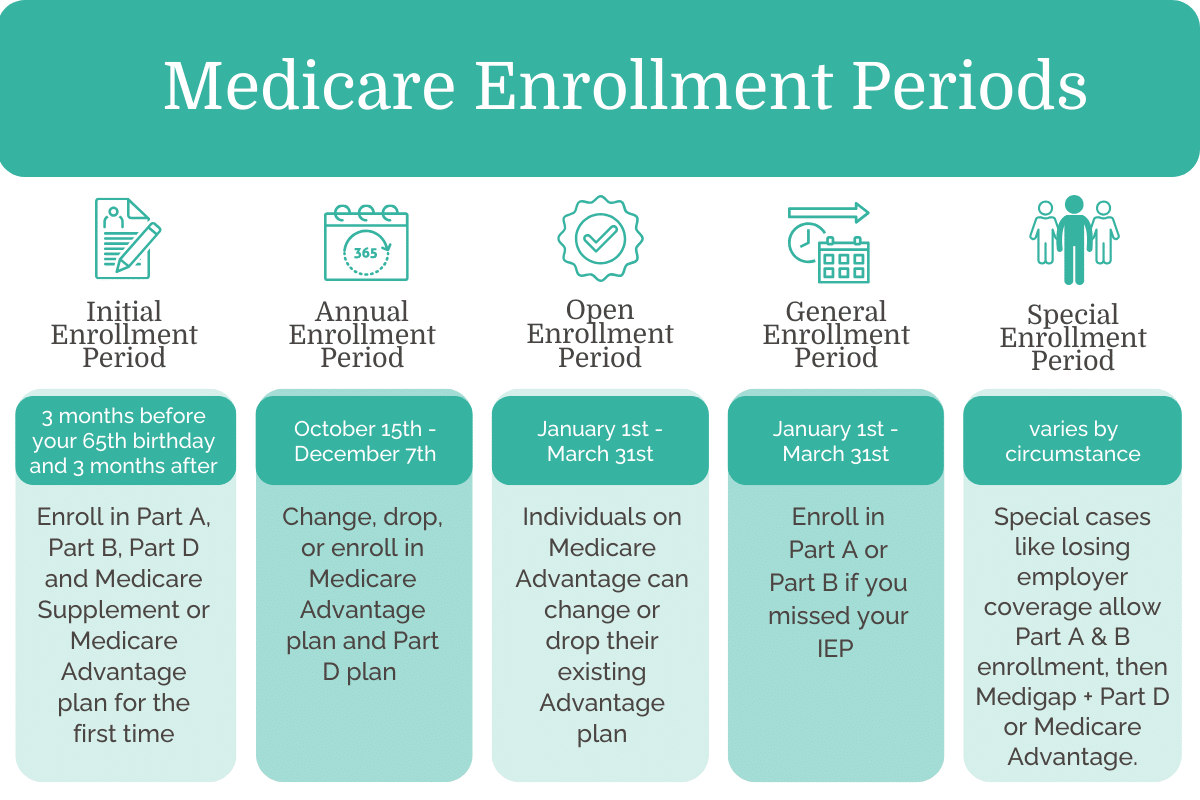
Medicare Enrollment Periods Explained
Medicare’s enrollment periods are easy to mix up. This table lays them side by side so you can find the one that fits.
Enrollment Period | Who Qualifies | When It Happens | Best For |
|---|---|---|---|
Initial Enrollment Period | People turning 65 | 7-month window around your 65th birthday | First-time enrollment |
General Enrollment Period | People who missed their IEP | January 1 to March 31, annually | Late enrollment |
Special Enrollment Period | People with a qualifying event | Varies by event (often 8 months) | Employer coverage changes |
Annual Enrollment Period | Existing beneficiaries | October 15 to December 7 | Changing plans |
Medicare Advantage Open Enrollment | Medicare Advantage members | January 1 to March 31 | Switching or dropping an MA plan |
Advantage Open Enrollment Period
If you’ve heard of the Medicare Advantage Open Enrollment Period, know it’s the same as the Medicare Annual Enrollment Period.
How to Enroll in Medicare
You have four ways to apply. Pick whichever suits how you prefer to handle paperwork.
Enroll Online
The fastest option is the Social Security website, where the application takes about 10 to 30 minutes. This works for Part A, Part B, or both.
Enroll Through Social Security
Because Social Security administers enrollment, you can start through your mySocialSecurity account, the same one that handles retirement benefits.
Enroll by Phone
Prefer a person? Call Social Security to enroll over the phone, a good route if you have questions or want confirmation as you go.
Enroll at a Local Social Security Office
You can also apply in person at a local office. Appointments are recommended, and bringing your documents keeps it short.
Our guide to apply for Medicare covers the steps in order, and this piece on how to apply for Medicare breaks down the form.
What Documents Do You Need to Enroll?
Gather these first:
✓ Social Security number
✓ Birth certificate
✓ Proof of U.S. citizenship or legal residency
✓ Employment information, including current and past coverage
✓ Details of any current insurance
✓ Banking information, if you are setting up premium payments
What Happens If You Miss Medicare Enrollment?
If you miss your enrollment window without qualifying for a Special Enrollment Period, you may face a gap in coverage and permanent late enrollment penalties added to your premiums for as long as you have Medicare.
The consequences stack up:
- Late enrollment penalties. Part B adds 10% to your premium for each full 12-month period you could have enrolled but did not. Part D adds 1% of the national base beneficiary premium ($38.99 in 2026) for each month without creditable drug coverage.
- Coverage gaps. You may wait until the General Enrollment Period and go uninsured for months.
- Delayed enrollment. General Enrollment Period coverage starts the month after you sign up.
- Permanent premium increases. Part B and Part D penalties are not one-time fees; they stay for life.
The numbers add up fast. Our guide to late enrollment penalties shows the math.
Common Medicare Enrollment Mistakes
Most enrollment problems come from a few avoidable errors:
- Missing the Initial Enrollment Period because no reminder ever came.
- Assuming enrollment is automatic when you actually needed to apply.
- Missing an employer coverage deadline after leaving a job.
- Waiting until retirement, then finding the window already closed.
- Not comparing plans and getting stuck with coverage that does not fit.
- Forgetting Part D and triggering a drug-coverage penalty.
Choosing a plan has its own pitfalls. Our list of mistakes to avoid when selecting a Medicare plan is worth a look.
Do You Need to Enroll If You're Still Working?
One of the most common questions, and the answer hinges on employer size, which determines who pays first. When your employer plan pays first, you can usually delay Part B without a penalty. When Medicare pays first, delaying can be costly.
Employer Size | Who Pays First | What It Means for You |
|---|---|---|
20 or more employees | Your employer plan | You can generally delay Part B penalty-free while you keep working. |
Fewer than 20 employees | Medicare | You usually need to enroll in Part B at 65 to avoid gaps and penalties. |
Creditable coverage means insurance at least as good as Medicare, which protects you from penalties when you delay. With 20 or more employees and that coverage, delaying Part B is usually safe. With fewer than 20, Medicare pays first, so delaying can leave you underinsured and penalized.
What Happens After You Enroll?
Once your application goes through:
- Your red, white, and blue Medicare card arrives in the mail.
- Coverage takes effect on your start date, based on when you enrolled.
- You decide whether to add a Medigap policy, Medicare Advantage plan, or Part D coverage.
- You take note of future windows, like the Annual Enrollment Period, for later changes.
Enrolling is only the first step. The coverage you build around Original Medicare shapes your care and costs.
Choosing Coverage After Medicare Enrollment
After enrolling, you have options:
- Original Medicare (Part A and Part B) is the federal foundation covering hospital and medical care.
- Medicare Supplement (Medigap) helps pay the out-of-pocket costs Original Medicare leaves.
- Medicare Advantage (Part C) bundles Medicare coverage through a private plan, often with extras.
- Part D adds prescription drug coverage, which Original Medicare does not include on its own.
To change supplemental coverage, see how to switch Medicare supplemental plans.
If a Medicare Advantage plan no longer fits, see how to switch Medicare Advantage plans
Medicare Enrollment Checklist
Use this quick checklist to keep your enrollment on track:
✓ Confirm your eligibility
✓ Determine which enrollment period applies to you
✓ Gather your documents
✓ Complete your application
✓ Verify your coverage effective date
✓ Review your Medicare card when it arrives
✓ Compare your coverage options
Not sure which enrollment period applies to you? Talk with a Medicare Guide before you decide.
Is Medicare Enrollment Complicated?
It can feel complicated, but a few points make it manageable:
- Most people can enroll successfully on their own.
- Timing is the single most important factor.
- Planning ahead is what prevents penalties.
- Personalized guidance removes the guesswork from decisions that matter.
The rules exist to make coverage work, not to trip you up. A little preparation goes far.
Talk to a Medicare Guide Before You Enroll
Medicare enrollment involves lasting decisions you need not face alone. A Medicare Guide can help you:
- Choose the right enrollment strategy.
- Avoid the costly mistakes that catch people off guard.
- Compare your coverage options.
- Get educational, no-pressure guidance built around you.
Not sure when or how to enroll? Talk with a Medicare Guide before you decide.
Frequently Asked Questions
When should I enroll in Medicare?
During your Initial Enrollment Period, the seven-month window around your 65th birthday, unless employer coverage lets you delay Part B without a penalty.
How do I enroll in Medicare?
Online through Social Security, by phone, or at a local office. If you already receive Social Security benefits, you may be enrolled automatically.
Is Medicare enrollment automatic?
Only if you already collect Social Security or Railroad Retirement benefits at 65, or have had disability benefits for 24 months. Otherwise, you apply yourself.
What happens if I miss Medicare enrollment?
You may face a coverage gap and permanent penalties: 10% on Part B per 12-month delay, plus monthly Part D charges, for as long as you have coverage.
Can I enroll in Medicare while still working?
Yes. With 20 or more employees, you can often delay Part B penalty-free. With fewer than 20, you usually need to enroll at 65.
What documents are required to enroll?
Your Social Security number, birth certificate, proof of citizenship or residency, employment and insurance details, and banking information for payments.
What is the Initial Enrollment Period?
The seven-month window from three months before your 65th birthday month to three months after. Signing up early lets coverage start on time.
What is a Special Enrollment Period?
A window to enroll outside the normal periods, penalty-free, after a qualifying event like losing employer coverage or retiring after 65.
Can I delay Medicare enrollment?
Only safely with creditable coverage, such as insurance from an employer of 20 or more. Delaying without it can trigger lifetime penalties.
Do I need Medicare Part B if I have employer insurance?
It depends on employer size. With 20 or more employees, you can often delay Part B; with fewer, Medicare pays first, so you generally need it at 65.
How long does Medicare enrollment take?
The application takes about 10 to 30 minutes, but processing and card delivery take a few weeks, which is why signing up early matters.
Can I change my Medicare plan after enrolling?
Yes. Adjust coverage during the Annual Enrollment Period each fall; other windows cover switching Medigap or Medicare Advantage plans.