


If you already have insurance through your job, do you need Medicare if you continue working once you turn 65? It depends, and getting it wrong can mean lasting penalties and coverage gaps. This guide explains how the two fit together, who pays first, when you can safely delay enrollment, and what to watch for as you near retirement.
Can You Have Both Employer Insurance and Medicare?
Yes, many people have both Medicare and employer-sponsored health insurance at the same time.
This is more common than most people realize. Workers who reach 65 and keep their jobs often stay on their group plan while enrolling in at least part of Medicare. Retirees sometimes carry retiree coverage alongside Medicare, and a spouse can be covered under one partner’s workplace plan while qualifying for Medicare on their own.
People carry both for different reasons. Some want the broader benefits an employer plan offers; others take premium-free Part A because it costs nothing. When you have two coverages, they coordinate: one pays first, and the other may cover what remains. That process, called “coordination of benefits,” drives nearly every decision in this guide.
New to this? Start with what is Medicare.
How Does Medicare Work With Employer Insurance?
When you have both Medicare coverage and employer coverage at the same time, the plans share your bills through coordination of benefits. The primary payer pays first, up to its limits; then, the secondary payer reviews what is left and decides which portion of the balance it will pay. If your employer plan is primary, the provider bills it first and Medicare reviews the balance. If Medicare is primary, the order reverses.
You don’t choose which plan comes first. Federal rules set it, and the biggest factor is the size of the employer providing the coverage.
Who Pays First: Medicare or Employer Insurance?
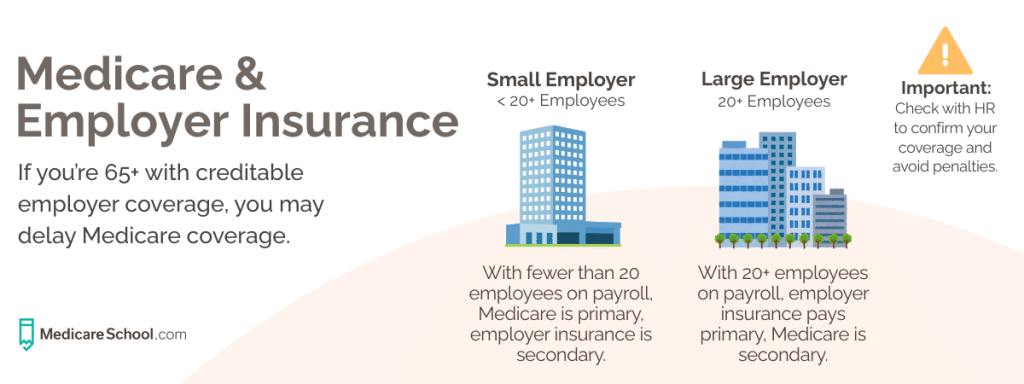
The answer mostly depends on how many people your employer employs.
| Employer Size | Primary Coverage |
|---|---|
| 20 or more employees | Employer insurance |
| Fewer than 20 employees | Medicare |
| Disabled, under 65 (100 or more employees) | Employer insurance |
| End-Stage Renal Disease (ESRD) | Varies by timing |
At larger companies, the employer plan generally pays first, letting workers delay Medicare without losing coverage.
At small companies, Medicare usually pays first, so skipping it can leave you underinsured. If Medicare should be primary and you have not enrolled, you may owe the share of any medical expenses you incur that it would have paid.
Do You Need Medicare If You Are Still Working?
Working past 65 does not automatically mean enrolling in every part of Medicare right away. The right move depends on your employer, your spouse’s coverage, and how you earn a living.
Working for a Large Employer (20 or More Employees)
If your employer has 20 or more employees and offers creditable coverage, your group plan usually pays first. Many people enroll in premium-free Part A and delay Part B until they stop working, avoiding a premium for coverage they do not yet need.
Working for a Small Employer (Fewer Than 20 Employees)
At a company with fewer than 20 employees, Medicare typically becomes primary once you are eligible, so enrolling in both Part A and Part B at age 65 is usually recommended. If you skip Part B and your employer plan pays only as secondary, you could face large gaps you will be responsible for.
Covered Under a Spouse’s Employer Plan
If you are covered through your spouse’s active employer plan, the same size rules apply, but they hinge on your spouse’s employer. A large employer may let you delay Part B; a small one often means you must enroll on time. Confirm with the benefits administrator rather than assuming.
Self-Employed Coverage Situations
Self-employment changes the picture. An individual or marketplace plan you buy on your own is not employer coverage based on active employment, so it usually does not let you delay Part B without a penalty. Enrolling during your Initial Enrollment Period is often the safest option.
Not sure whether you qualify? Review who is eligible for Medicare.
| Not sure whether to keep employer coverage or enroll in Medicare? A short conversation can save you from a costly mistake. Talk to a Medicare Guide. |
Can You Delay Medicare Part B Without a Penalty?
Yes, but only under specific conditions. The protection that lets you delay Part B safely is the Special Enrollment Period, or SEP. You generally qualify if both of these are true:
- You have coverage through current, active employment, either your own or your spouse’s.
- That coverage is creditable, meaning it is at least as good as Medicare’s standard.
When you meet those conditions, you can delay Part B while working and enroll later without a penalty – generally up to eight months after the coverage ends.
Delaying is risky when coverage isn’t tied to active employment. Retiree coverage and COBRA do not count and can trigger a lifelong penalty and a coverage gap.
Our guide on when to enroll for Medicare breaks down each window.
What Happens When You Retire?
Retirement is when these decisions come to a head. Once active employment ends, the clock starts on enrolling, and missing the window can be expensive.
Retirement Before Age 65
If you retire before 65, you are not yet eligible by age. You will need a bridge plan, such as a marketplace plan, retiree coverage, or COBRA. None replaces Medicare, so plan to enroll in Medicare during your Initial Enrollment Period as your 65th birthday approaches.
Retirement After Age 65
If you relied on active employer coverage to delay Part B, your Special Enrollment Period begins when that coverage ends. You generally have up to eight months to enroll without a penalty, but do not wait the full term if you want coverage to start promptly.
Spouse Retirement Scenarios
If your coverage runs through your spouse’s job, your protection ends when your spouse retires or loses that coverage. Treat their retirement as your signal to review your own enrollment.
Common Employer Coverage and Medicare Mistakes
Most coverage problems trace back to a few avoidable errors:
- Assuming enrollment is automatic. Unless you already receive Social Security, you usually have to sign up yourself.
- Missing Part B deadlines. A missed window can mean a permanent penalty added to your premium.
- Relying on COBRA incorrectly. It does not count as active coverage and will not protect you from Part B penalties.
- Misreading employer size rules. The 20-employee threshold sets who pays first, and guessing wrong can leave you underinsured.
- Delaying too long. Even with a valid reason to wait, going past your window creates penalties and gaps.
Weighing supplemental coverage? See choosing the best supplement plan.
Medicare and COBRA: What You Need to Know
COBRA is one of the most misunderstood pieces of this topic, and the mistake can be costly. It lets you continue a former employer’s group coverage for a limited time after you leave a job. It feels like employer coverage, but for Medicare purposes it is not, because it is not based on current, active employment.
| Warning: COBRA does not replace Medicare enrollment requirements.
COBRA is not active employer coverage. It does not give you a Special Enrollment Period for Part B, and it does not protect you from the late enrollment penalty. If you are 65 or older and relying on COBRA, you generally still need to enroll in Medicare on time. |
If you delay Part B because you have COBRA, you can face a penalty and a coverage gap once it ends. If you are eligible, enrolling in Part B during your Initial Enrollment Period is usually safer.
Medicare and Employer Insurance Costs
Having both coverages can mean paying two premiums, so weigh what you get in return. Premium-free Part A can pay secondary on hospital bills at no cost. Part B carries a monthly premium that only pays off when Medicare is primary or fills real gaps.
For how the bills get paid, see insurance premiums and Medicare.
Should You Keep Employer Coverage After Enrolling in Medicare?
There is no one-size-fits-all answer. It hinges on your benefits, your family’s needs, and your timeline.
Keeping both may make sense when your employer benefits are strong, you need to cover family members on the same plan, or your workplace drug coverage is robust and creditable.
Dropping employer coverage may make sense when your premiums are high relative to what you use, you are retiring, and the coverage will end anyway, or Medicare with a supplement or Advantage plan would serve you better.
What Coverage Options Should You Consider After Leaving Employer Insurance?
When employer coverage ends, Medicare becomes your foundation, and you will want coverage that fills its gaps. Three options are worth understanding.
Medicare Supplement (Medigap) Plans
Medigap works alongside Original Medicare to cover costs like coinsurance and deductibles, with broad provider access and predictable spending. Compare options in our Medigap plans guide, and to weigh two popular choices, see Medigap plan N or G.
Medicare Advantage Plans
Medicare Advantage bundles your coverage through a private insurer, often adding extra benefits and drug coverage, with networks and out-of-pocket limits. If your situation changes, learn how to switch Medicare Advantage plans.
Prescription Drug Plans
With Original Medicare and a Medigap plan, you will likely need a standalone Part D drug plan. Leaving creditable drug coverage without picking up Part D on time can trigger a separate penalty, so handle prescriptions deliberately.
Is Employer Coverage Better Than Medicare?
Neither option is universally better. The right choice depends on what your employer offers and where you are in your career.
| Factor | Employer Coverage | Medicare |
|---|---|---|
| Cost | Often subsidized, but varies widely by plan | Part A is usually free; Part B and add-ons carry premiums |
| Networks | Depends on the group plan; narrow or broad | Original Medicare is widely accepted; Medicare Advantage uses networks |
| Flexibility | Limited to the plans your employer offers | Multiple supplement and Medicare Advantage options |
| Long-Term Stability | Ends when employment ends | Stays with you for life once enrolled |
There is no universal answer. A generous employer plan may outshine Medicare while you work, yet Medicare offers stability that follows you into retirement. The best decision depends on your benefits and your timeline.
Talk to a Medicare Guide Before Making Coverage Decisions
These decisions carry consequences that follow you for years. A knowledgeable guide can help you avoid penalties and choose coverage that fits, including:
- A full review of your current employer and Medicare coverage
- Retirement planning built around your enrollment deadlines
- Hands-on Medicare enrollment assistance
- Clear, educational consultation with no pressure
When you are ready to map out your next step, contact Medicare School.
Frequently Asked Questions
Can I have both employer insurance and Medicare?
Yes. The coverages coordinate based on federal rules and employer size.
How does Medicare work with employer insurance?
They coordinate benefits. The employer plan pays first as primary; the other reviews the balance as secondary. Employer size decides which is which.
Who pays first, Medicare or employer insurance?
With 20 or more employees, the employer plan usually pays first. With fewer than 20, Medicare usually does. Disability and ESRD follow separate rules.
Do I need Medicare if I am still working?
Not always. Creditable coverage from a large employer often lets you take Part A and delay Part B. Small employers and self-employment usually call for enrolling on time.
Can I delay Medicare Part B?
Yes, with creditable coverage through current, active employment. That qualifies you for a Special Enrollment Period with no penalty.
Does COBRA count as employer coverage?
No. It is not based on active employment, so it does not trigger a Part B Special Enrollment Period and does not protect you from the late penalty.
What happens when I retire?
Your protection to delay Part B ends when you stop working. You typically have up to eight months to enroll without a penalty.
Is employer insurance better than Medicare?
It depends. An employer plan may serve you well while you work; Medicare offers stability into retirement.
Can I keep my spouse on employer coverage?
Often yes, depending on your plan. Your spouse’s ability to delay Part B ties to your active employment and employer size.
What should I do before retirement?
Review your benefits, verify your eligibility, compare your options, and confirm your deadlines.